Glaucoma Surgery
At Hill Vision Services, we offer sight-saving glaucoma care for the St. Louis area. By using the most advanced technological methods, our ophthalmologists are able to detect, prevent, monitor, and effectively treat glaucoma.
The best form of protection is prevention, so schedule your eye exam today to see if you are one of the millions of patients with glaucoma.
What Is Glaucoma?
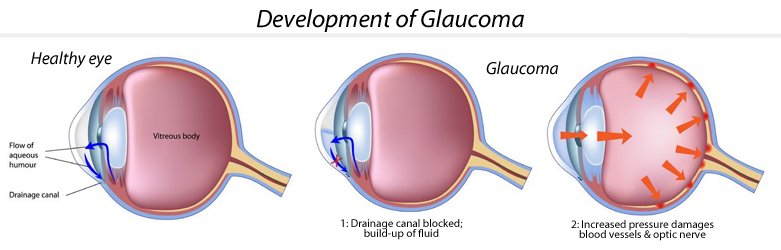
Glaucoma is an eye disease that slowly and often unknowingly steals an individual’s ability to see over time. It is a disease of the optic nerve, the pathway connecting the eyeball and retina to the brain. Although the relationship is complex, patients with glaucoma generally have elevated intraocular pressure. This dangerous buildup of internal eye pressure causes slow, but progressive damage to the optic nerve either by “pressing” on its microscopic fibers or by reducing the blood flow to them. The exact mechanism is complex, and there are even some patients who develop the disease despite relatively normal eye pressures.
Open-angle Glaucoma
Most patients diagnosed with this eye disease, approximately 90%, have what is known as open-angle glaucoma. Here, the fluid in the front of the eye, known as the aqueous humor, is able to easily pass through the eye’s drainage channel, but the “drain” (also known as the trabecular meshwork) is not as effective as it once was.
Narrow-angle Glaucoma
The other 10% have what is known as narrow-angle glaucoma. In this case, the path to the drain is narrowed and the normal flow of aqueous humor is compromised. In rare cases, the narrow type may be an acute event accompanied by severe pain and rapid loss of vision.
Whether open or narrow, both types typically result in elevated eye pressure and gradual loss of vision. Often called the “silent thief of sight,” glaucoma may produce no symptoms until the disease progresses and causes irreparable harm. This is why it is so important for patients to have their eye pressure checked and to be screened.
Don't let glaucoma steal your sight—contact us today to schedule your eye exam!
Glaucoma Treatment
When you schedule a routine eye exam with Hill Vision Services, a complete and thorough examination will be done. In addition to checking your intraocular pressure (IOP) to determine if fluid is not draining properly, our ophthalmologists and optometrists perform tests such as visual field testing, optic nerve fiber analysis, and direct visualization of the nerve. These tests, all important pieces of the puzzle, give us a sense of how the nerve appears (versus what is considered normal) as well as how the nerve is functioning. Our eye doctors can then confirm the diagnosis of glaucoma or rule out any other problems.
Once diagnosed, subsequent treatment of glaucoma is aimed at trying to lower the eye pressure and could include medicated drops, laser procedures, glaucoma surgery, or a combination of these treatments.
Glaucoma Eye Drops
Medicated eye drops aimed at lowering IOP are usually the first line of defense for controlling glaucoma. If you have open-angle glaucoma, we may prescribe one or more of the following eye drops:
However, if medication does not alleviate the internal pressure, then other surgical options may be explored.
- Prostaglandins - These drops increase the outflow of aqueous fluid from the eye and typically are used once daily.
- Rho-kinase inhibitor - These drops are prescribed for once-a-day use and reduce IOP by increasing aqueous fluid drainage from the eye.
- Beta-blockers - These drops slow the production of aqueous in your eye to reduce eye pressure and may be prescribed for use once or twice daily, depending on your specific needs.
- Carbonic anhydrase inhibitors - These drops reduce the production of fluid in the eye and are usually prescribed for use twice a day.
- Alpha-adrenergic agonists - These drops can both reduce aqueous production and increase aqueous drainage, they may be prescribed for use twice or three times a day.
- Combination eye drops - There also are glaucoma eye drops that are a combination of medicines. If you need more than one medicine to control your eye pressure, this may be a convenient and effective option.
Laser trabeculoplasty
Laser trabeculoplasty is a procedure done to treat open-angle glaucoma. It uses a laser to help the fluid in your eye drain away. Before the treatment, drops will be put in your eye to make it numb. During the treatment, you will sit in front of a laser machine where the doctor will aim a strong beam of light into your eye using a special lens. You may see flashes of bright green or red light during the treatment. Most people feel little or no pain or discomfort during the treatment.
Glaucoma Surgery
Surgery can be an effective way of treating glaucoma and preventing further vision loss. In addition to glaucoma surgery, the doctors at Hill Vision Services can combine this surgical procedure with one to treat cataracts as well. This can be beneficial and convenient for a variety of older adults suffering from both conditions. You can learn more about the iStent® by clicking on this link:
Learn about iStent®
This surgery will help lower the eye pressure while simultaneously reducing the number of prescription drops that patients must use to control glaucoma. In some cases, surgery can even eliminate the need for drops altogether.
DSLT
Direct Selective Laser Trabeculoplasty (DSLT) is a non-contact laser that lowers intraocular pressure in patients with glaucoma or ocular hypertension. It is designed for patient comfort, with a fully automated experience and no lens placed on the eye.
What does DSLT treatment look like?
Scan the QR code to see it in action

Durysta
DURYSTA® (bimatoprost intracameral implant) is a prescription medicine to reduce eye pressure (also called intraocular pressure, or IOP) in patients with open angle glaucoma or high eye pressure (ocular hypertension).
DURYSTA should not be used if:
- You have any infection or suspected infection in your eye or surrounding eye area
- You have corneal endothelial cell dystrophy, a condition in which the clear front layer of your eye (cornea) has lost its ability to work normally and can cause vision problems
- You have had a corneal transplant or cells transplanted to the inner layer of the cornea (endothelial cell transplant)
- The sack that surrounds the lens of your eye (posterior lens capsule) is missing or torn
- You are allergic to any of its ingredients
DURYSTA may cause side effects involving the cornea, including increased risk of loss of cells from the inner layer of the cornea. You should not receive DURYSTA more than once in each eye. DURYSTA should be used with caution if you have a limited reserve of the cells lining the inner layer of the cornea.
DURYSTA should be used with caution if you have narrow or obstructed iridocorneal angles (the space where the iris, the colored part of the eye, and cornea meet).
DURYSTA may cause swelling of the macula, the center spot of the retina (back of the eye). DURYSTA should be used with caution if your eye does not have a lens, if you have an artificial lens and a torn posterior lens capsule, or if you have any risk factors for swelling of the macula.
DURYSTA may cause inflammation inside the eye or make existing inflammation worse.
DURYSTA may cause increased brown coloring of the iris, which may be permanent.
Eye injections, including DURYSTA, have been associated with infections in the eye. It is important that you contact your doctor right away if you think you might be experiencing any side effects after an injection, including eye redness, sensitivity to light, eye pain, or a change in vision. Your doctor should monitor you following DURYSTA administration.
The most common side effect involving the eyes reported in patients using DURYSTA was eye redness. Other common side effects reported were feeling like something is in the eye, eye pain, being sensitive to light, a blood spot on the white of the eye, dry eye, eye irritation, increased eye pressure, a loss of cells on the inner layer of the cornea, blurry vision, inflammation of the iris, and headache.
You are encouraged to report negative side effects of prescription drugs to the FDA. Visit www.fda.gov/medwatch or call 1-800-FDA-1088.
If you are having difficulty paying for your medicine, AbbVie may be able to help. Visit AbbVie.com/PatientAccessSupport to learn more.
Please see full Prescribing Information, or visit https://www.rxabbvie.com/pdf/durysta_pi.pdf.